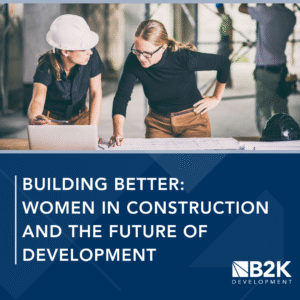
Building Better: Women in Construction and the Future of Development
As the construction industry observes Women in Construction Week, it’s worth examining both how far the field has come in welcoming women professionals and how much opportunity remains to expand their presence across all roles, from trades and project management to executive leadership and ownership.
The statistics tell a clear story. Women represent roughly 11% of the construction workforce nationally, with even lower percentages in field positions. Yet projects and companies that successfully attract and retain women professionals consistently report benefits: improved safety records, enhanced problem-solving approaches, stronger team communication, and better project outcomes.
The evidence is clear: the construction industry benefits from women’s participation. As industry leaders, our responsibility is creating pathways that enable more women to pursue and advance in construction careers.
 Changing Industry Culture
Jon Weiss, Principal and President of Construction at B2K Development and President of the Long Island Builders Institute (LIBI), has watched the industry evolve over three decades in construction.
“When I started in this field, job sites were almost exclusively male spaces,” Weiss reflects. “that’s changed, but not fast enough. The women who’ve entered construction have consistently proven they can excel in every role, from skilled trades to project management to company leadership. The challenge is creating environments where women can see themselves succeeding long-term.”
Cultural change happens through both policy and practice. Companies that successfully attract women professionals share common approaches: zero-tolerance policies for harassment or discrimination, mentorship programs pairing experienced professionals with newcomers, flexible scheduling that acknowledges family responsibilities, and leadership actively modeling inclusive behavior.
At B2K Development, projects are managed by teams that prioritize professional respect and collaboration. The company’s work across residential, senior living, and mixed-use development creates opportunities to partner with professionals and subcontractors from various backgrounds, including women-owned businesses.
Breaking Down Barriers
The barriers facing women entering construction are well-documented: lack of exposure to construction as a career option, concerns about workplace culture, limited access to apprenticeship and training programs, and challenges balancing demanding schedules with family responsibilities.
Industry organizations like LIBI play important roles in addressing these systemic challenges. Through advocacy, education, and policy development, trade associations can influence how the entire industry approaches workforce development.
“As LIBI President, one of my priorities is supporting programs that introduce young people, including young women, to construction careers,” Weiss explains. “That means working with high schools, vocational programs, and community colleges to show students that construction offers excellent career paths with strong wages, opportunities for advancement, and the satisfaction of building things that serve communities.”
The industry needs women across all roles, not just in traditional “office” positions, but in trades, site supervision, equipment operation, and field management. Each role requires different recruitment approaches and support structures.
Women Leading at B2K
The impact of women in construction is evident in the professionals who contribute to B2K Development’s projects daily. Two Assistant Project Managers exemplify the expertise and dedication women bring to the field.
Diane Ambrosio has spent 20 years in construction, working directly with owners, project managers, field superintendents, and accounting teams across B2K’s portfolio. Her experience spans the full project lifecycle, from initial planning through completion.
“I love the industry and find it very exciting to see the buildings go up from start to finish and what it entails to get there,” Ambrosio says. Her perspective reflects what draws many professionals to construction, the tangible satisfaction of creating lasting infrastructure that serves communities.
Marguerite Bynum, a SUNY Empire State graduate from Farmingdale who now lives in Amityville, grew up watching her father work in construction for 40 years. As an Assistant Project Manager currently working on projects across Long Island and Queens, she may supervise as many as 175 workers on any given site.
“There is no greater feeling than starting with nothing and helping to shape it into a finished project that people will live in or work in,” Bynum explains. her path into construction felt natural given her family background, but her success comes from dedication and expertise developed over years in the field.
Bynum acknowledges the challenges faced by earlier generations of women in construction while noting positive changes in workplace culture. “I am greatly aware of the obstacles that the women who came before me faced,” she reflects. “I can only imagine the discrimination they faced and the roadblocks they had to overcome, but thankfully that is not the workplace environment I have had to deal with. From the day I entered the industry, I have been surrounded by colleagues who took the time to teach me and share their expertise.”
The professional respect she experiences demonstrates how construction culture can evolve when companies prioritize inclusive environments. “I am treated with respect,” Bynum notes. “I have found that if you treat your colleagues with respect, they will do the same. I am not viewed as the woman on the team, but a valuable team member and I am most appreciative of that.”
Both women represent the professional expertise that benefits construction projects and companies. Their presence on B2K Development teams contributes to better project outcomes while demonstrating paths other women can follow into construction careers.
The Next Generation
Perhaps the most important work involves exposing young women to construction careers before they’ve already committed to other fields. High school is often when career paths begin forming, yet construction remains largely invisible to young women as a viable option.
This requires industry-wide effort. Construction companies can host job site tours for student groups, participate in career days, offer internships and apprecnticeships, and partner with vocational programs. Trade associations can develop educational materials, sponsor scholarship programs, and connect students with mentorship opportunities.
“We need young women to see construction as a field where they can build meaningful careers,” Weiss emphasizes. “That means showing them real examples of women who’ve succeeded in construction, the variety of roles available, the earning potential, and the satisfaction of building projects that serve communities for decades.”
The business case for attracting more women to construction is compelling. The industry faces signifiant workforce shortages projected to worsen as older workers retire. Construction cannot afford to recruit from only half the population.
Looking Ahead
Women in Construction Week provides an opportunity to celebrate progress while acknowledging work remaining. The women currently working in construction, whether as electricians, carpenters, project managers, engineers, or company leaders, demonstrate daily that gender has no bearing on construction competency.
The industry’s challenge is creating enough pathways for more women to follow their lead. That requires sustained effort from construction companies, trade associations, educational institutions, and policymakers working together to remove barriers and create opportunities.
At B2K Development, the commitment extends beyond individual projects to industry-wide improvement. Through work with LIBI and ongoing efforts to create professional, respectful work environments, the company contributes to making construction accessible to all qualified professionals regardless of gender.
“The future of construction depends on attracting the best talent available,” Weiss concludes. “That means women need to see construction as a field where they can succeed, advance, and build rewarding careers. Companies that figure this out first will have competitive advantages in attracting talented professionals. More importantly, they’ll be helping build an industry that better serves communities by drawing on everyone’s capabilities.”
As the construction industry continues evolving, expanding women’s participation across all roles remains both a business imperative and the right approach to building stronger teams, better projects, and more resilient companies. Women in Construction Week reminds the industry to maintain focus on this important work.